| |
 |
STUDY IN Poland - Educational
System IN POLAND |
| |
| |
 |
| |
| | |
| |
| |
|
| |
Institution Types
and Credentials |
| |
|
Types of higher education institutions:
- Uniwersytety (Universities)
- Politechniki (Technical Universities)
- Akademie Medyczne (Medical Academies)
- Akademie Rolnicze (Agricultural Academies)
- Akademie Ekonomiczne (Economical Academies)
- Wyzsze Szkoly Pedagogiczne (Higher Teacher
Education Schools)
- Akademie Muzyczne, Sztuk Pieknych,Teatralne
I Filmowe (Academies of Music, Fine Arts,Theatre,and
Cinematography)
- Akademie Wychowania Fizycznego (Academies
of Physical Education)
- Akademie Teologiczne (Theological Academies)
- Szkoly Morskie (Merchant Marine Academies)
- Szkoly Wojskowe (Military Schools)
- Wyzsza Szkola Policji (School of Police)
- Panstwowe Wyzsze Szkoly Zawodowe (State Schools
of Higher Vocational Education)
- Niepanstwowe Szkoly Wyzsze (Non-Public Schools)
- Niepanstwowe Wyzsze Szkoly Zawodowe (Non-state
Schools of Higher Vocational Education)
School leaving and higher education credentials:
- Swiadectwo dojrzalosci
- Swiadectwo ukonczenia (of a given school)
- Inzynier
- Licencjat
- Dyplom ukonczenia studiów wyzszych
- Lekarz
- Lekarz stomatolog
- Lekarz weterynarii
- Magister
- Magister edukacji
- Magister inzynier
- Magister inzynier architek
- Magister sztuki
- Licencjat II
- Master
- Swiadectwo ukonczenia studiów podyplomowych
- Doktor
- Kwalifikacje pierwszego stopnia
- Doktor habilitowany
- Kwalifikacje drugiego stopnia
|
|
| [BACK
TO TOP] |
|
| |
Structure of Education
System |
| |
Pre-higher education:
Duration of compulsory education:
Age of entry: 7
Age of exit: 18
Structure of school system:
Primary
Type of school providing this education: Primary
School (Szkola Podstawowa)
Length of program in years: 6
Age level from: 7 to: 13
Certificate/diploma awarded: Swiadectwo ukonczenia
szkoly podstawowej - Certificate of Completion
of Primary School Education)
Lower Secondary
Type of school providing this education: Gimnasium
(Gimnazjum)
Length of program in years: 3
Age level from: 13 to: 16
Certificate/diploma awarded: Swiadectwo ukonczenia
gimnazjum (Certificate of Completion of Education
in the Gymnasium)
Technical Secondary
Type of school providing this education: Technikum
(Technical Secondary School)
Length of program in years: 4
Age level from: 16 to: 20
Certificate/diploma awarded: Swiadectwo dojrzalosci
technikum (Maturity Certificate of the Technical
Secondary School) or swiadectwo ukonczenia Technikum
(Certificate of Completion of Education in the
Technical Secondary School)
Upper Secondary
Type of school providing this education: Liceum
Ogólnoksztalcace (General Lyceum)
Length of program in years: 3
Age level from: 16 to: 19
Certificate/diploma awarded: Swiadectwo dojrzalosci
liceum ogólnoksztalcacego (Maturity Cetificate
of the General Lyceum) or swiadectwo ukonczenia
liceum ogólnoksztalcacego (Certificate
of Completion of Education in the General Lyceum)
Vocational Secondary
Type of school providing this education: Szkola
Zasadnicza (Basic Vocational School)
Length of program in years: 3
Age level from: 16 to: 19
Certificate/diploma awarded: Swiadectwo ukonczenia
szkoly zasadniczej (Certificate of Completion
of Education in the Basic Vocational School)
Vocational Secondary
Type of school providing this education: Liceum
Profilowane (Specialized Lyceum)
Length of program in years: 3
Age level from: 16 to: 19
Certificate/diploma awarded: Swiadectwo dojrzalosci
liceum profilowanego (Maturity Certificate of
the Specialized Liceum) or swiadectwo ukonczenia
liceum profilowanego (Certificate of Completion
of Education in the Specialized Lyceum) |
| |
| [BACK
TO TOP] |
|
| |
|
|
| |
| [BACK
TO TOP] |
|
| |
|
School Education
BEFORE THE 1999 REFORM, primary education lasted
for 8 years leading to the conferring of the Swiadectwo
Ukonczenia Szkoly Podstawowej (Certificate of
Completion of Primary School Education). Secondary
general education was provided in the four-year
general lyceum (lyceum ogólnoksztalcace).
Secondary vocational education was provided by
a range of schools , i.e. four-year liceum ( lyceum),
liceum zawadowe (vocational lyceum), liceum techniczne
(technical lyceum) and a 5-year technikum (secondary
technical school). The graduates of all secondary
schools were awarded either the Swiadectwo Dojrzalosci
(Maturity Certificate of a given kind of secondary
school) or the Swiadectwo Ukonczenia (Certificate
of Completion of Education in the given kind of
secondary school). Apart from that, there were
basic vocational schools (szkola zasadnicza) whose
graduates obtained the Swiadectwo Ukonczenia Szkoly
Zasadniczej (Certificate of Completion of Education
in the basic vocational school).
AFTER THE 1999 REFORM, 6-year primary schools
and 3-year gymnasia were introduced. Secondary
education is provided in 3-year general lyceums
(liceum ogólnoksztalcace) or in vocational
secondary schools such as the 3-year liceum profilowane
(specialized lyceum) and 4-year technikum (secondary
technical school). In addition, there are 2-3-year
basic vocational schools (zasdnicza szkola zawodowa)
whose graduates obtain the Swiadectwo Ukonczenia
Zasadniczej Szkoly Zawodowej (Certificate of Completion
of Education in the Basic Vocational School).
The secondary school credentials of the former
system will be issued until 2005. In the transition
period, both the former and the new types of secondary
school will co-exist. The credential that gives
right to enter higher education before and after
the reform is the Swiadectwo Dojrzalosci issued
after completion of education in a secondary school
and having passed the Maturity examination (Egzamin
Dojrzalosci/ Matura).The only type of post-primary
school that does not give access to higher education
is the basic vocational school, both in the old
and new system. The graduates of these schools
may continue their education in different types
of complementary secondary schools: liceum uzupelniajace
(complementary lyceum) or technikum uzupelniajace
(complementary technical secondary school). Following
completion of education in these schools they
can pass the maturity examination and obtain a
Maturity Certificate and thus become eligible
for entrance to higher education
Higher Education
The higher education system comprises both state
and non-state institutions. The latter are created
on the basis of the 1990 Higher Education Act.
Before that, there were only state higher education
institutions (with the exception of the Catholic
University of Lublin). When the Act on Schools
of Higher Professional Education came into force
in 1997, courses of higher professional education
were created. Thus, at present, there are both
university-type and non-university type (professional
education) institutions in Poland. Graduates of
higher professional courses (offered by panstwowe
wyzsze szkoly zawodowe and wyzsze szkoly zawodowe)
are awarded the professional title of licencjat
or inzynier after 3-4 years' study. Graduates
of university-type higher education institutions
are awarded the professional title of magister
or an equivalent after having followed uniform
5-year magister level courses or 1.5 to 2-year
complementary magister level courses (in the case
of holders of the professional title of licencjat
or inzynier obtained either at university-type
institutions or institutions of higher professional
education).
Most higher education institutions
are under the responsibility of the Ministry of
National Education and Sport. Some, however, are
under the control of other competent Ministries:
Ministry of Health (Academies of Medicine) and
Ministry of Culture (Academies of Music, Fine
Arts, Theatre, and Film Studies). There are also
schools that are supervised by the Ministry of
National Defence (military schools), the Ministry
of Internal Affairs (Main School of Fire Service,
School of Police) and the Ministry of Infrastructure
(merchant navy schools).The total number of state
higher education institutions is 116 and there
are 182 non-state higher education institutions.
The credential giving access to higher education
is the swiadectwo dojrzalosci (Maturity Certificate)
of a given kind of secondary school. The most
common form of recruitment is the entrance examination.
Academic Year:
- Classes from: Oct to: Jun
- Long vacation from: 1 Jul to: 30 Sep
Languages of instruction:
Polish
Stages of studies:
- Non-university level post-secondary studies (technical/vocational
type):
Non-university level:
Non-university level education in Poland is provided
by szkoly policealne and szkoly pomaturalne. The
szkoly policealne train students in a variety
of vocational fields. The graduates obtain the
swiadectwo ukonczenia szkoly policealnej (certificate
of completion of education in post-secondary school),
and can then take a vocational examination and
obtain the dyplom uzyskania tytulu zawodowego
(vocational title diploma). The vocational training
in this type of schools lasts between 1 and 2.5
years, depending on the field of studies.The szkoly
pomaturalne train only nurses and midwives, and
the graduates are awarded the dyplom ukonczenia
szkoly pomaturalnej (diploma of completion of
education in the post-secondary school). The duration
of education is 2.5 years. Since 1999 the training
of nurses and midwives is organized as higher
studies.
University level studies:
University level first stage:
First level studies are organized both by university-type
higher education institutions and the institutions
of higher professional education (wyzsze szkoly
zawodowe). The graduates obtain the dyplom ukonczenia
studiów wyzszych (diploma of completion
of higher studies) and are awarded the professional
title of licencjat or inzynier after completing
the education and preparing a thesis or diploma
project. The duration of studies is 3 to 4 years,
depending on the field of study. The graduates
can continue their education at university-type
institutions in complementary courses of the second
level and obtain the title of magister or equivalent.
The professional title of licencjat has been awarded
since 1992, when new regulations concerning the
qualifications in higher education were announced.Military
schools and the School of Police award the graduates
of first level studies the title of oficer dyplomowany.
The Main School of Fire Service grants them the
title of inzynier pozarnictwa.
University level second stage:
The studies of the second stage are organized
in the university-type higher education institutions
as uniform studies lasting 5-6 years or as complementary
studies, lasting 1.5 - 2 years, and offered to
holders of the professional titles of licencjat
or inzynier. The graduates receive dyplom ukonczenia
studiów wyzszych (diploma of completion
of higher studies) and are awarded the title of
magister or one of its equivalents after submitting
and defending of a thesis or a diploma project
(with the exception of the studies in Medicine).
The holders of the title of magister or its equivalent
may continue their education at postgraduate level.These
are the professional titles awarded by different
kinds of second level higher education studies
lasting usually 5 years (it is indicated when
the duration of studies is different):- universities:
graduates are awarded the title of magister;-
technical universities: graduates are awarded
the title of magister inzynier;- academies of
medicine: graduates are awarded the title of lekarz
(in Medicine, after 6 years of studies) or lekarz
stomatolog (in Dentistry, after 5 years of studies);
the title of magister is awarded to graduates
in the fields of Pharmacy and others after 5 years
of studies;- academies of agriculture: graduates
are awarded the title of magister inzynier or
lekarz weterynarii (in Veterinary Medicine, after
5.5 years);- academies of economics: graduates
are awarded the title of magister or magister
inzynier (in some faculties);- teacher-training
schools: graduates are awarded the title of magister
edukacji or magister; - schools of arts: graduates
are awarded the title of magister sztuki;- academies
of physical education: graduates are awarded the
title of magister, additionally they are granted
the professional title of trener, instruktor rekreacji
or instruktor turystyki;- academies of theology:
graduates are awarded the title of magister;-
merchant navy schools: graduates are awarded the
title of magister inzynier;- military schools:
graduates are awarded the title of magister, magister
inzynier or lekarz (at Wojskowa Akademia Medyczna
w Lodzi, after 6 years of studies); additionally,
they are also granted the military rank of podporucznik
(second lieutenant);- Main School of Fire Service:
graduates are awarded the title of magister inzynier
pozarnictwa;- non-state higher education schools
and higher education institutions of the Catholic
Church and other confessions can award the title
of magister.
University level third stage:
The academic degree of doktor can be obtained
in two ways: by students of doctoral (postgraduate)
studies, lasting usually 3-4 years, or by persons
who combine their professional work with academic
research and elaboration of a dissertation. All
candidates must hold the professional title of
magister or equivalent. To be awarded the degree
of doktor, the candidate must submit and successfully
defend a doctoral dissertation assessed positively
by two supervisors and pass doctorate examinations.The
degree of doktor can be conferred either by higher
education institutions or by research institutes
entitled to award it. The name of the qualification
awarded as an equivalent to the degree of doktor
in artistic disciplines is kwalifikacje pierwszego
stopnia (first degree qualifications).
University level fourth stage: Doktor Habilitowany:
The degree of doktor habilitowany is awarded
to candidates who already hold the degree of doktor.
It can be obtained either by academic staff of
higher education institutions and research units,
or by persons who combine their research work
with other professional activities. To be awarded
the academic degree of doktor habilitowany the
candidate must: have remarkable scientific or
artistic achievements; submit a habilitation dissertation
which contributes to the development of a given
scientific iscipline; receive a favourable assessment
of his/her dissertation from three supervisors;
pass a habilitation examination and deliver a
favourably assessed habilitation lecture. The
name of the qualification awarded in artistic
disciplines as an equivalent to the degree of
doktor habilitowany is kwalifikacje drugiego stopnia
(second degree qualifications).The holders of
the doktor habilitowany degree are eligible for
the academic post of professor at higher education
institutions and can be awarded the academic title
of profesor conferred by the President of the
Republic of Poland. |
| |
| [BACK
TO TOP] |
|
| |
Teacher Education:
Training of pre-primary and primary/basic school
teachers
Since 1990, teacher training in Poland is organized
as tertiary education. Primary school and gymnasium
teacher are trained in a kolegium nauczycielskie
(teacher training college). There are also foreign
language teacher training colleges (nauczycielskie
kolegium jezyków obcych). The graduates
are awarded the dyplom ukonczenia kolegium nauczycielskiego
and the professional title of licencjat (conferred
by the higher education institution which supervises
the given college).Before 1990, the education
of pre-primary and primary teachers was organized
in a range of secondary/postsecondary teacher
training schools. The qualification awarded was
swiadectwo dojrzalosci (maturity certificate)
and/or dyplom ukonczenia … of a given kind
of school (diploma of completion of education
in …. institute). The education of the graduates
of primary schools who wanted to become teachers
lasted from 4 to 6 years, and that of graduates
of secondary schools 2 or 3 years. The names of
those teacher training schools and institutes
are: liceum pedagogiczne (teacher training lyceum),
studium nauczycielskie (teacher-training institute),
studium wychowania przedszkolnego (pre-primary
education institute), studium nauczania poczatkowego
(beginning learning institute), pedagogiczne studium
techniczne (technical teacher training institute).
Training of secondary school teachers
Holders of the degree of magister or its equivalent
who have pursued a pedagogical course are eligible.
Since 1990 secondary school foreign language teachers
can also be trained in foreign language teacher
training colleges (nauczycielskie kolegium jezyków
obcych). The graduates are awarded the dyplom
ukonczenia kolegium nauczycielskiego and the professional
title of licencjat (conferred by the higher education
institution which supervises a given college).
Training of higher education teachers
Academic teachers are recruited among the holders
of academic degrees of doktor and doktor habilitowany.
The academic teachers of lower grade can be graduates
of higher education institutions, i.e. holders
of the degree of magister or its equivalent, who
are preparing for the doctorate.
Non-traditional studies:
Lifelong higher education
Higher education institutions and research institutes
can organize courses for holders of higher education
diplomas (magister equivalent), the aim of which
is to update or develop their professional or
academic knowledge. Graduates of these courses
are awarded the swiadectwo ukonczenia studiów
podyplomowych (certificate of completion of postgraduate
studies). The duration of the programme depends
on the field of study and the institution. |
| |
|
| |
|
| |
|
| |
| [BACK
TO TOP] |
|
| |
National Bodies |
| |
|
Ministry of Education
and Sport (Ministerstwo Edukacji Narodowej I Sportu)
al. Szucha 25
00-918 Warszawa
Poland
Tel: +48(22) 628-04-61
Fax: +48(22) 629-71-11
Telex: 813523 men pl
eMail: minister@menis.gov.pl
WWW: http://www.menis.pl
Role of governing body: Creating educational
policies at the national level, coordinating other
governing bodies, controlling higher education
institutions supervised by this Ministry
Central Council of
Higher Education (Rada Glówna Szkolnictwa
Wyzszego)
al. Szucha 25
00-918 Warszawa
Poland
Tel: +48(22) 629-84-78
Fax: +48(22) 628-84-78
Role of governing body: Cooperates with the Minister
of National Education and the other national bodies
in the implementation of tasks concerning higher
education; in particular, defines the requirements
for organizing new fields of study an the conferring
of professional titles, as well as minimum curriculum
requirements for each field of study
Polish Universities
Rectors' Conference
ul. Wieniawskiego 1
00927 Poznan
Poland
Tel: +48(61) 829-43-92
Fax: +48(61) 829-44-44
EMail: rectorof@amu.edu.pl
WWW: http://www.krasp.org.pl
State Accreditation
Commission (Panstwowa Komisja Akredytacyjna)
al. Szucha 25
00-918 Warszawa
Poland
Tel: +48(22) 622-36-86
Fax: +48(22) 622-36-86
EMail: pka@menis.gov.pl
Role of governing body: Quality assurance, advisory
and controlling tasks in establishing new higher
education institutions and concession of licences
to organize new fields of study in the existing
ones
Central Commission
for Academic Degrees and Titles (Centralna Komisja
do Spraw Stopni Naukowych i Tytulu Naukowego
Palac Kultury I Nauki
pl. Defilad 1
00-901 Warszawa
Poland
Tel: +48(22) 826-82-38 +48(22) 620-33-24
Fax: +44(22) 620-33-24
Role of governing body: Supervises the conferring
of the academic degrees of Doktor and Doktor Habilitowany;
entitles the faculties of the higher education
institutions and to research units to award these
academic degrees.
|
| |
|
| [BACK
TO TOP] |
|
| |
Admissions to Higher Education |
| |
|
Admission to non university higher education
studies
Name of secondary school credential required:
Swiadectwo dojrzalosci
Minimum score/requirement: 2 - mierny (mediocre)
in the grading scale introduced in 1991; 3 - dostateczny
(satisfactory) in the grading scale used before
1991
For entry to: szkola policealna
Name of secondary school credential required:
Swiadectwo ukonczenia (of a given school)
Minimum score/requirement: 2 - mierny (mediocre)
in the grading scale introduced in 1991; 3 - dostateczny
(satisfactory) in the grading scale used before
1991
For entry to: szkola policealna, szkola pomaturalna
Entrance exams required:
For some courses (according to the institutions)
there is an entrance examination. Some institutions
also have qualifying tests or qualifying interviews
for access to some of their courses.
Other admission requirements:
Sometimes physical and mental predisposition
of candidate to exercise a given profession must
first be ascertained
Admission to university-level studies
Name of secondary school credential required:
Swiadectwo dojrzalosci
Minimum score/requirement: 2 - mierny (mediocre)
in the grading scale introduced in 1991; 3 - dostateczny
(satisfactory) in the grading scale used before
1991
For entry to: all institutions of higher education
Entrance exams required: For some courses (according
to the institutions) there is an entrance examination.
Some institutions also have qualifying tests or
qualifying interviews for access to some of their
courses.
Numerus clausus/restrictions: Higher education
institutions are autonomous in this matter. The
number of students is decided by the senate of
each institution.
Other admission requirements: Prize-winners of
national competitions (olimpiada) in various secondary-school
subjects are exempt from entrance examinations.
|
|
| [BACK
TO TOP] |
|
| |
Grading System |
| |
|
Usual grading system in secondary school
Full Description: 6 - 1 (excellent (celujacy),
very good (bardzo dobry), good (dobry), satisfactory
(dostateczy), unsatisfactory (niedostateczny),
mediocre (mierny),fail: often, the marks '+' and
'-' are added to the principal grades)
Highest on scale: 6 (excellent)
Pass/fail level: 2 (satisfactory)
Lowest on scale: 1 (fail)
Main grading system used by higher education
institutions
Full Description: 5 - 2 (5 very good, 4 good,
3 satisfactory, 2 unsatisfactory)
Highest on scale: 5 (very good)
Pass/fail level: 3 (satisfactory)
Lowest on scale: 2 (unsatisfactory)
Other main grading systems
For non-final exams, the marks '+' and '-' are
often added to the principal grades. In some schools
the grade 6 (excellent) exists.
|
|
| [BACK
TO TOP] |
|
| |
Information on the National Education System |
System of Higher Education
Both state and private institutions of higher
education exist in Poland. The latter began to
appear after 1990. A private school of higher
education must receive permission to operate from
the Ministry of National Education and Sport.
It acquires a legal status then registered by
the Minister of National Education and Sport.
In 1998 the first state and private vocational
schools of higher education began to appear. These
schools train students in vocational/professional
specializations and prepare them for specific
professions by including 15-week internships and
school practice in the mandatory curriculum. Study
programs can take the form of daily, evening or
extramural studies and distant learning courses.
Daily studies is the prevalent form.
To qualify for admission to an institution of
higher education, the applicant must hold the
secondary school certificate (swiadectwo dojrzalosci).
The rules of admission to the first year of study
are determined autonomously by each institution.
Some organize competitive entrance examinations,
others use ranking procedures based on the final
grades listed in the secondary school certificate,
still others admit all who apply.
Professional titles awarded to graduates of institutions
of higher education:
- the professional title of licencjat is awarded
following the completion of 3 or 3.5 years of
professional training;
- the professional title of inzynier is awarded
following the completion of 3.5 or 4 years of
professional studies in technical areas, agriculture
and economics and business;
- the title of magister is awarded following
the completion of a 5 year program of professional
studies in a given discipline; equivalent titles
include magister edukacji (in the field of Education),
magister sztuki (in the field of Fine Arts),
magister inzynier (in the fields of Engineering)
and magister inzynier archtekt (in the field
of Architecture). Medical and veterinary studies
last 6 years and the titles lekarz medycyny
(in the field of Medicine), lekarz stomatolog
(in the field of Stomatology) and lekarz weterynarii
(in the field of Veterinary). The title of magister
can also be obtained following the completion
of 2 or 2.5-year complementary magister's programs,
for which holders of the professional title
of licencjat or inzynier are eligible.
To be awarded any of the above professional titles
the student must complete all subjects and internships
or practice included in the program of study,
submit and defend a diploma project or thesis
and pass a diploma examination. Upon graduation,
each student receives a diploma in a specific
discipline, three copies of the diploma and, upon
request, a diploma in a foreign language.
The Act of the Academic Title and Academic Degrees
regulating the award of academic titles and degrees
establishes the following academic ranks (in ascending
order):
- the academic degree of doktor of a particular
academic subject area within a particular academic
discipline.
- the academic degree of doktor habilitowany
of a particular academic subject area within
a particular academic discipline.
- the title of profesor of a particular academic
subject area.
The degree of doktor is granted to persons who
having obtained the professional title of magister
(or its equivalent) and having passed the appropriate
doctoral examinations have submitted and successfully
conducted a public defense of a Ph.D. thesis which
must also be examined by at least two specialists.
The thesis, written under the supervision of a
tutor, should present the author’s original
solution to an academic problem, and display the
author’s general theoretical knowledge within
the relevant academic discipline, and ability
to undertake independent academic research.
The degree of doktor habilitowany is awarded
to persons who have obtained a doctorate, whose
scientific attainments are extensive, and who
have submitted an habilitation dissertation, successfully
participated in an habilitation colloquium, and
have delivered a habilitation lecture. The habilitation
dissertation is to be reviewed by at least three
specialists and should be considered to be a significant
contribution by the author to the development
of a particular academic discipline.
The title of profesor is granted to persons who
after obtaining the degree of doktor habilitowany
have proceeded to both outstanding academic attainments
and important educational achievements (successful
management of a research team could be understood
as such an educational achievement). The assessment
of these achievements must be supported by the
opinions of at least three specialists.
The degrees of doktor and doktor habilitowany
can be granted by the faculty boards of university
faculties (or the academic councils of institutes,
including non-teaching institutes such as those
of the Polish Academy of Sciences) of appropriate
academic standing. The right to grant higher degrees
is accorded by the Central Commission for Matters
Related to Academic Title and Degrees, the members
of which are chosen by an electoral college consisting
of all Polish Professors. In certain cases resolutions
granting the degrees of doktor habilitowany have
the force of law only after confirmation by the
Central Commission.
The title of profesor if granted by the President
of the Republic of Poland and the bases of a resolution
of the Central Commission issued in response to
a petition by an academic council of sufficient
standing to be entitled to grant the degree of
doktor habilitowany.
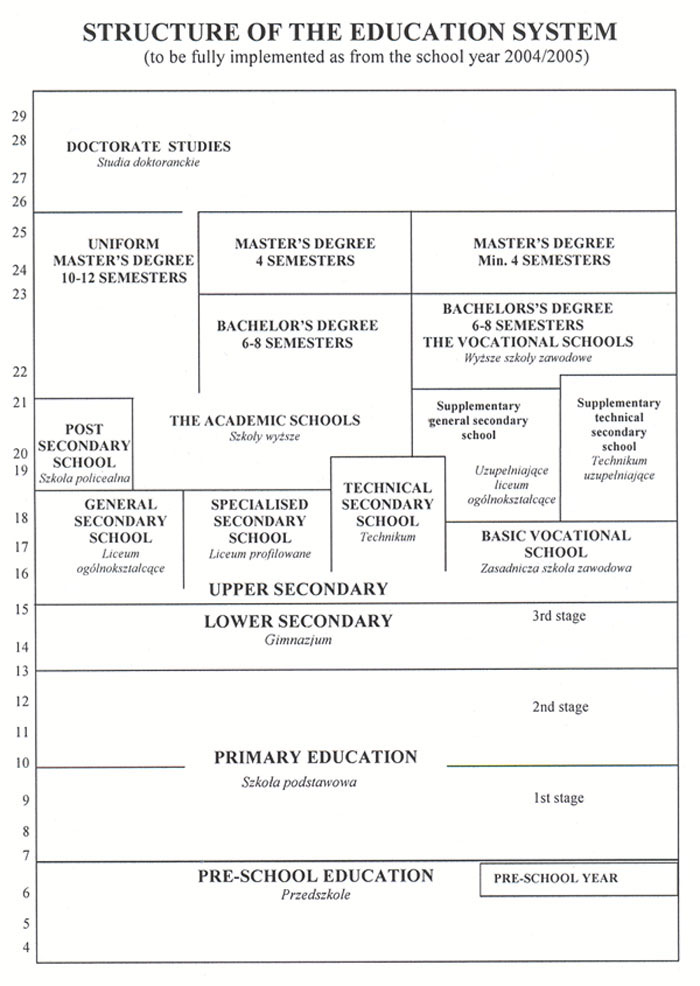
Structure of the Education System -
Diagram

The system, as presented in the diagram, is to
be fully implemented from the school year 2004/2005. |
|
| [BACK
TO TOP] |
|
| |
| Source: http://www.euroeducation.net/prof/polaco.htm |
| |
| |
|
|
|
|
|